
In Conversation with Our Newest Advisors
Feature
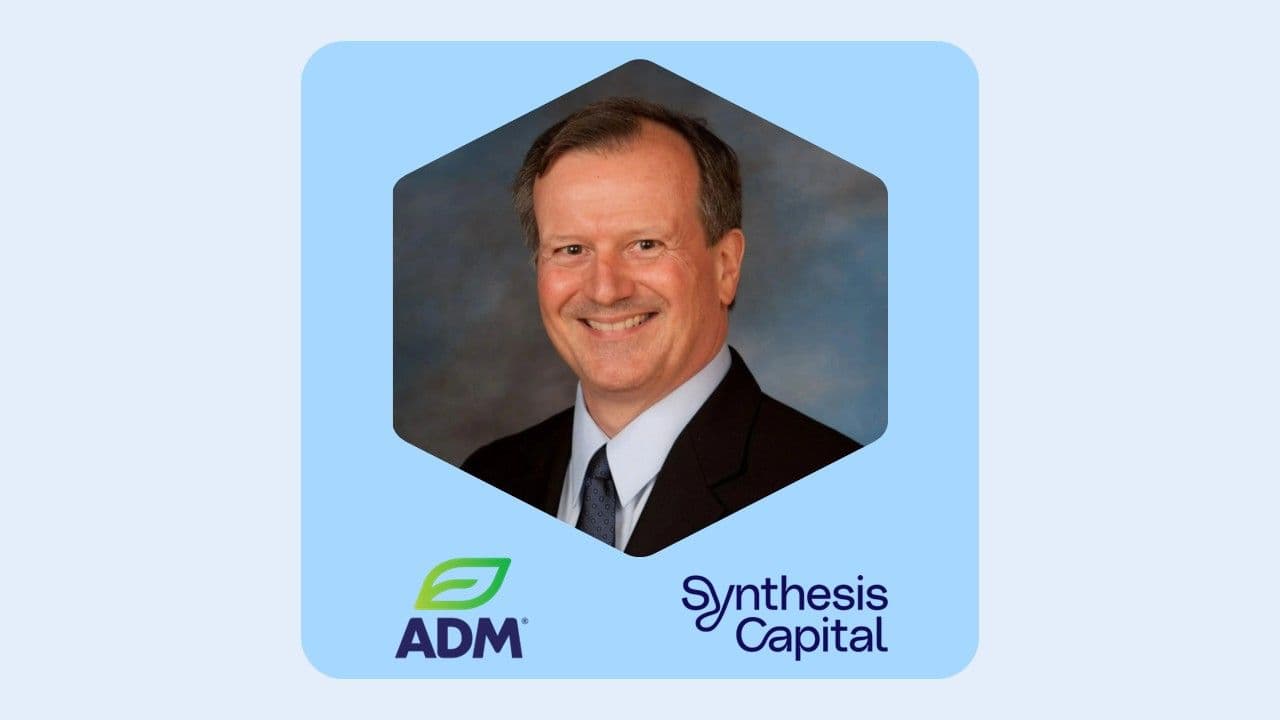
One of the advisors we have been fortunate to work with since the very earliest days of Synthesis is Mark Matlock. Over a career spanning four decades at Archer Daniels Midland (ADM), Mark rose from analytical chemist to Senior Vice President of Food Research, directing food ingredient and applications research at one of the world’s largest agribusinesses. Along the way, he helped bring a series of now-familiar ingredients to market, and also played a central role in multiple ADM acquisitions.
Many of the companies we back are pursuing precisely the sort of ingredient innovations that Mark spent his career championing through ADM, which makes his view from the other side of the table especially valuable.
We sat down with Mark to talk about what makes an incumbent get behind an innovation, what the best acquirers are really looking for, and his experience of working with Synthesis.
For a fuller introduction to Mark, visit “Our Team”.
Rosie: Over four decades at ADM, you helped bring new ingredients to market (food-grade xanthan gum, enzyme-modified soy protein isolates, trans-free solid fats) from inside one of the world’s largest agribusinesses. Many of our founders are trying to get a novel ingredient adopted by exactly these kinds of incumbents. From the other side of the table, what makes a big company get behind an innovation rather than let it stall? And what do founders tend to get wrong about how those decisions really get made?
Mark: It helps to start with what actually drives the food ingredient business, which historically has come down to supply and cost. The openings to change things tend to arrive through one of two doors: new market demand or new nutrition science. Each of the ingredients you mentioned came through one of those doors.
Xanthan gum is a good example. The opportunity came out of the 1992 USDA food pyramid, which put fats and oils right at the top (to be used sparingly). Our customers responded by reformulating full-fat products into low-fat and no-fat versions, and one of the biggest categories was salad dressing, where fat is what gives you viscosity and mouthfeel. Xanthan gum was the key ingredient that let you make a credible no-fat dressing. ADM already had fermentation capabilities, so it was a very logical thing to bring into the portfolio, and we began producing it in 1995.
The trans-fat work came through a different door: new nutrition science. As the science on trans fats and LDL cholesterol firmed up in the late 1990s, we needed a way to make low-trans solid fats, and so we partnered with Novozymes, who had developed a way to immobilise lipases on silica. That was the technology we scaled and commercialised, and it went on to earn a Presidential Green Chemistry Award for the environmental side of it.
The common thread is that a large company invests behind an external innovation when it sees an opportunity for growth or for cost reduction (ideally both), and when it believes it can commercialise that innovation at scale. So as a founder you have to think hard about strategic fit: how does your ingredient fit their production assets and capabilities, where does it sit in their existing portfolio, and how does it fit the customers they already supply? That same dynamic is very much alive today. With roughly one in six people in the US now on GLP-1 therapies, the historical growth engine of snacking is being de-emphasised, and protein and fibre have become the top two priorities for developers, who tell me they are trying to get protein into everything they can. The barrier is almost always taste and texture, so there is real opportunity for technologies that add protein or fibre without compromising either.
As for what founders get wrong: in a startup, decisions are made by a small handful of people, and unless you have worked inside a large company, it is genuinely hard to appreciate how many people touch a decision there. It’s not just R&D and marketing, it’s production engineering, finance, regulatory, legal (both intellectual property and contract law), top management, sometimes even investor relations. Every one of them plays some part. The best way to navigate that infrastructure, which is often complicated and quite opaque from the outside, is to find an internal champion for your technology, someone who can shepherd it through all those groups far more effectively than you can from the outside. Meet people at scientific meetings and learn how the company is organised. Is it more market-led (where marketing carries the decisions), or more technology-led (where R&D has more of a say)? Use that to find the right person. You can have someone on the marketing side who loves your product, but without buy-in from the other groups it will still stall.
Rosie: You played a key role in ADM’s acquisitions of Wild Flavors and Biopolis. As our portfolio companies mature, many will become acquisition targets or acquirers themselves. Beyond the technology, what do the best acquirers look for? And what should a founder be doing early on to be ready if a buyer comes calling?
Mark: Again, the first words that come to mind are “strategic fit”, but Wild Flavors and Biopolis are useful precisely because they illustrate two very different kinds of fit.
Wild Flavors, in 2014, was about global footprint and customer intimacy. I flew from Decatur to Heidelberg with Juan Luciano, now ADM’s CEO, and Greg Morris, who now runs our largest business unit, to meet Hans-Peter Wild, the billionaire who had built both Wild Flavors and Capri-Sun. It gave us natural flavours and natural colours, which matter even more now given the natural-colour trend, but just as importantly, it gave us local technical support around the world. We were a global business, but a very US-centric one on R&D. Wild Flavors was European-centric with strong positions in China and India. They say: “think globally, act locally”. The act-locally piece was what we were missing, and this let us put people in front of customers in their own markets. And the portfolios had essentially zero overlap (there was not a single product both of us sold), so it broadened what we could offer a customer rather than duplicating it.
Biopolis was the other side of the coin. There we were following the science of the gut microbiome, and Biopolis could discover functional probiotics (strains that reduced inflammation, others that enhanced immune response, others that reduced visceral fat) along with genomic sequencing. They also happened to be based in Valencia (Spain) rather than Silicon Valley, and affordability is one of the financial metrics an acquirer has to meet, so location genuinely mattered. That connects to a framing our then-CTO Todd Werpy used often: “is this technology you want to own, or technology you want to rent?” Startups can play a valuable role in either. Genomic sequencing, in the early days, was something we chose to rent, because it was changing so fast. We sequenced our first microbial genome around 1998 and it cost us a million dollars.
For a founder, all of this comes back to looking at things from the acquirer’s standpoint rather than your own. You are naturally focused on your technology and the value you perceive in it, but you also need to ask what your technology is worth in this company’s hands versus that company’s. What channels to market they have that others don’t, and how your product sits in their portfolio. Is it complementary, or does it cannibalise part of their current business? If it cannibalises, you will meet pushback from whichever group stands to lose, even if it’s a clear opportunity for someone else. You can learn a great deal about all of this from a company’s investor calls and 10-K filings before you even walk in the door.
For alternative proteins specifically, I would add one practical point: it’s far easier to sell a protein that delivers functionality at a low inclusion rate, than one included purely for its nutritional value, where you are competing head-to-head with soy protein on an inclusion basis. If you can provide texture, emulsification, heat gelling or similar at a low inclusion rate, cost per pound becomes much less of a factor, and it fits your scale-up (in the early days you simply don’t have large volumes to sell, so a little in a broad range of products suits you better than a lot in a few). Have your protein and physical chemists really understand your product’s functionality, its interaction and synergies with other ingredients, the value proposition it brings and the cost in use; and always ask what you are displacing: if the incumbent ingredient is a by-product of something else, the cost you have to beat may be lower than the market price suggests.
The last thing I would say is to remember the customer beyond the acquirer. When your ingredient reaches the CPG company that puts it into the end application, that is an expensive process for them (R&D, shelf-life testing, packaging changes, processing changes). The value you bring has to overcome all of that. You are not just selling to the acquirer, you are selling to the next customer down the chain. It can be well worth hiring a consultant who has sat inside a CPG company to get that feedback early, from the people who would ultimately have to formulate with your ingredient.
Rosie: What made you want to work with Synthesis, and what has your experience of working with the team been like so far?
Mark: I was introduced to Synthesis by David Welch, who I knew from the Good Food Institute. When David approached me about advising, Synthesis was brand new, so I called a few friends at ADM Ventures, whom I had worked with in the latter part of my ADM career. They knew Costa, Rosie, and the team and knew their track record in the space, and after those conversations I was very enthusiastic about joining.
I now speak with David every couple of weeks, and he pulls me into portfolio companies where I can help with a particular question. In a few cases where a company wants deeper involvement, I take on separate consulting arrangements and I also help evaluate new opportunities. A lot of what I bring is simply forty years of having seen things go around and come around. But honestly, the part I enjoy most is the people. Meeting the founders and seeing their enthusiasm and ideas has been a fantastic experience. It has made my retirement from corporate life a lot of fun!
Thank you to Mark for providing his insights for this piece, and for his trusted guidance and counsel over the past four years!
This website uses strictly necessary cookies to enable the website to function, namely to secure our website and to save certain preferences and repeat visits, including recording your cookies preferences.
If you agree, we would also like to use non-essential cookies to enable us to observe traffic levels to the website which allows us to understand interaction with the website and helps us to improve the website and our services.
To learn more about this, visit our Cookie Policy. You may consent or decline to the use of non-essential cookies by clicking “Accept Cookies” or “Decline Cookies” below.